CPA Review Platform: White-Label AI Exam Prep Expansion to the Philippine CPA Licensure Exam
CPA Review Platform: White-Label AI Exam Prep Expansion to the Philippine CPA Licensure Exam
CPA Review Platform: White-Label AI Exam Prep Expansion to the Philippine CPA Licensure Exam
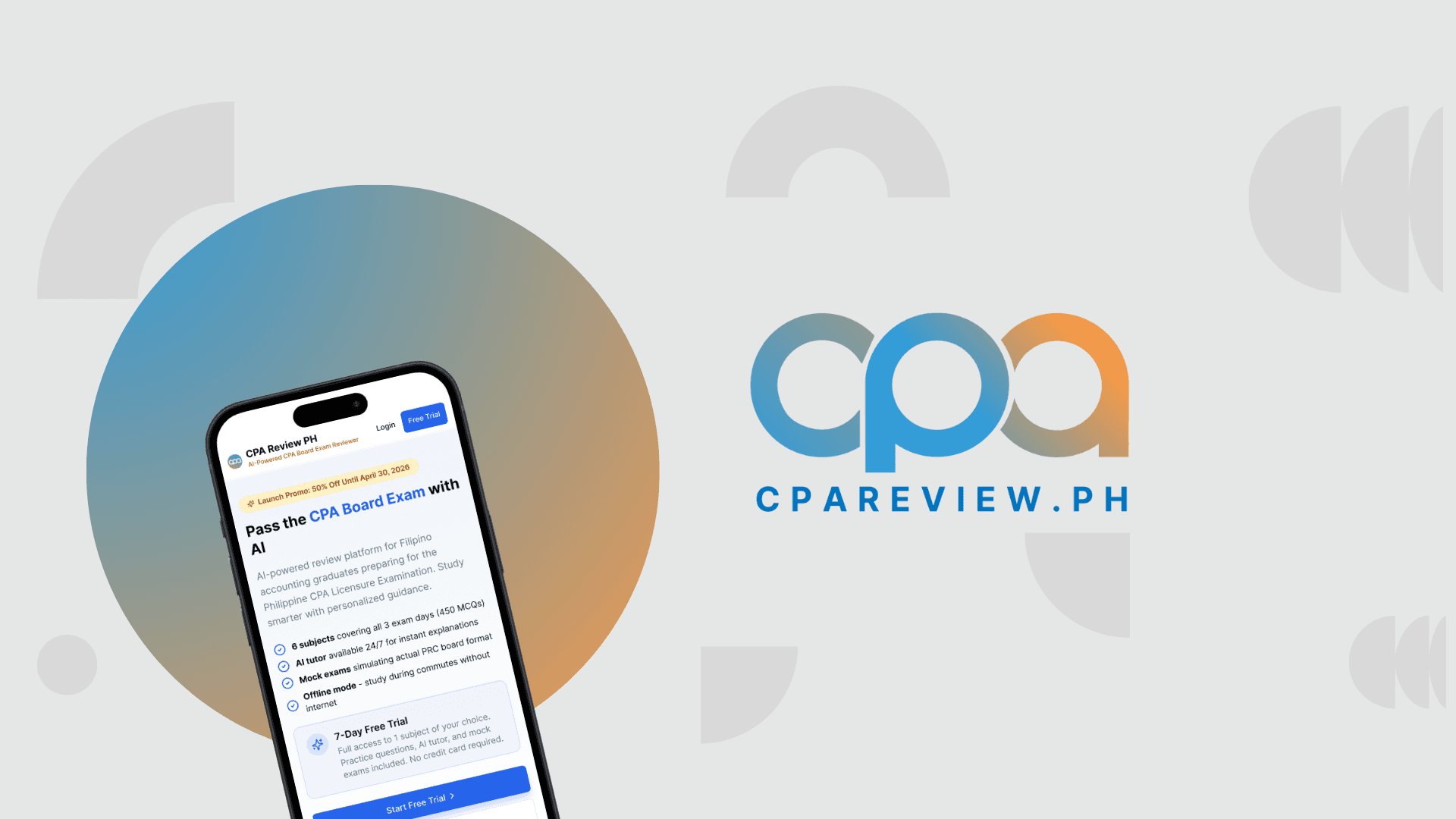
CPA Review Platform
Category: EdTech / AI / SaaS Product
Timeline: 2025-2026 (Live)
Product Type: IOL Own Product (White-label of CAT Platform)
URL: cpareview.ph
The Problem
The Philippine CPA Licensure Examination (CPALE) is one of the country's most challenging professional board exams, covering six subjects: Financial Accounting & Reporting (FAR), Advanced Financial Accounting & Reporting (AFAR), Management Advisory Services (MAS), Auditing Theory & Practice (AUD), Taxation (TAX), and Regulatory Framework for Business Transactions (RFBT). With approximately 10,000 examinees per sitting and two sittings per year, the market is substantial.
Yet the exam preparation landscape is dominated by traditional classroom review centers charging tens of thousands of pesos per review cycle. These centers require physical attendance, follow fixed schedules, and offer no personalized learning paths. For working professionals and students in provinces, the barriers are both financial and geographic. Meanwhile, global AI-powered exam platforms like Becker (USD 2,500-6,000) target the US CPA exam exclusively, leaving the Philippine CPALE market virtually unserved by modern learning technology.
Our Solution
Rather than building a new platform from scratch, we leveraged the white-label architecture engineered into the CAT Review Platform. This architectural decision — made during the earliest design phase of the CAT platform — paid dividends immediately. The CPA Review Platform shares the same RAG-based AI tutor, semantic search engine, PDF processing pipeline, and subscription management system, with CPA-specific content modules layered on top.
Content modules cover all six CPALE subjects with topic-coded question banks, difficulty distribution matching actual board exam patterns (Easy/Moderate/Difficult), and compliance with current Philippine Financial Reporting Standards (PFRS/PAS). A content review system ensures that AI-generated practice questions are verified for accuracy, with computational problems including step-by-step solutions.
What makes this platform unique in the Philippine market is the combination of deep accounting domain expertise and AI-native architecture. The platform was built by a CPA who understands what examinees need, not just by developers implementing features from a requirements document.
Key Features
All 6 CPALE Subjects: Complete coverage across FAR, AFAR, MAS, AUD, TAX, and RFBT with topic-coded question banks.
AI-Generated Practice Questions: Difficulty distribution matching board exam patterns, with automatic verification against current PFRS/PAS standards.
Computational Problem Verification: Step-by-step solutions for quantitative questions, ensuring accuracy in calculations.
Same White-Label Engine: Shared infrastructure with the CAT Review Platform, confirming the scalability of the architecture.
White-Label for Other PRC Exams: The same engine can be deployed for other PRC-administered licensure exams, with exam-specific content modules layered on top of the shared infrastructure.
Results & Impact
The platform is live at cpareview.ph with a few hundred registered users. Early adoption confirms the white-label architecture works — the same core engine powering CAT Review now serves CPA examinees with subject-specific content. Global players remain focused on the US CPA exam, leaving the Philippine CPALE market open.
Key Takeaways
White-label architecture enables product expansion — same engine, different content, new market.
Domain expertise (CPA background) is difficult for purely tech-led competitors to replicate.
The Philippine professional exam prep market is large and underserved by technology.
FAQ
Q: How is cpareview.ph different from traditional review centers?
A: It offers AI-powered personalized tutoring accessible anywhere, anytime, at a fraction of the cost of traditional classroom review centers. The AI tutor adapts to each student's level and provides context-aware guidance based on actual study materials.
Q: Does the platform cover all CPALE subjects?
A: Yes, cpareview.ph covers all six CPALE subjects: FAR, AFAR, MAS, AUD, TAX, and RFBT, with topic-coded question banks and difficulty-matched practice exams.
Q: Can the platform support other licensure exams?
A: Yes. The white-label architecture allows the same core engine to be deployed for other PRC-administered licensure exams with exam-specific content modules.
Q: Who built cpareview.ph?
A: The platform was built by IOL Inc., led by CEO Kevin Philip Gayao, CPA, MBA — combining deep accounting domain expertise with AI development capabilities.
CPA Review Platform
Category: EdTech / AI / SaaS Product
Timeline: 2025-2026 (Live)
Product Type: IOL Own Product (White-label of CAT Platform)
URL: cpareview.ph
The Problem
The Philippine CPA Licensure Examination (CPALE) is one of the country's most challenging professional board exams, covering six subjects: Financial Accounting & Reporting (FAR), Advanced Financial Accounting & Reporting (AFAR), Management Advisory Services (MAS), Auditing Theory & Practice (AUD), Taxation (TAX), and Regulatory Framework for Business Transactions (RFBT). With approximately 10,000 examinees per sitting and two sittings per year, the market is substantial.
Yet the exam preparation landscape is dominated by traditional classroom review centers charging tens of thousands of pesos per review cycle. These centers require physical attendance, follow fixed schedules, and offer no personalized learning paths. For working professionals and students in provinces, the barriers are both financial and geographic. Meanwhile, global AI-powered exam platforms like Becker (USD 2,500-6,000) target the US CPA exam exclusively, leaving the Philippine CPALE market virtually unserved by modern learning technology.
Our Solution
Rather than building a new platform from scratch, we leveraged the white-label architecture engineered into the CAT Review Platform. This architectural decision — made during the earliest design phase of the CAT platform — paid dividends immediately. The CPA Review Platform shares the same RAG-based AI tutor, semantic search engine, PDF processing pipeline, and subscription management system, with CPA-specific content modules layered on top.
Content modules cover all six CPALE subjects with topic-coded question banks, difficulty distribution matching actual board exam patterns (Easy/Moderate/Difficult), and compliance with current Philippine Financial Reporting Standards (PFRS/PAS). A content review system ensures that AI-generated practice questions are verified for accuracy, with computational problems including step-by-step solutions.
What makes this platform unique in the Philippine market is the combination of deep accounting domain expertise and AI-native architecture. The platform was built by a CPA who understands what examinees need, not just by developers implementing features from a requirements document.
Key Features
All 6 CPALE Subjects: Complete coverage across FAR, AFAR, MAS, AUD, TAX, and RFBT with topic-coded question banks.
AI-Generated Practice Questions: Difficulty distribution matching board exam patterns, with automatic verification against current PFRS/PAS standards.
Computational Problem Verification: Step-by-step solutions for quantitative questions, ensuring accuracy in calculations.
Same White-Label Engine: Shared infrastructure with the CAT Review Platform, confirming the scalability of the architecture.
White-Label for Other PRC Exams: The same engine can be deployed for other PRC-administered licensure exams, with exam-specific content modules layered on top of the shared infrastructure.
Results & Impact
The platform is live at cpareview.ph with a few hundred registered users. Early adoption confirms the white-label architecture works — the same core engine powering CAT Review now serves CPA examinees with subject-specific content. Global players remain focused on the US CPA exam, leaving the Philippine CPALE market open.
Key Takeaways
White-label architecture enables product expansion — same engine, different content, new market.
Domain expertise (CPA background) is difficult for purely tech-led competitors to replicate.
The Philippine professional exam prep market is large and underserved by technology.
FAQ
Q: How is cpareview.ph different from traditional review centers?
A: It offers AI-powered personalized tutoring accessible anywhere, anytime, at a fraction of the cost of traditional classroom review centers. The AI tutor adapts to each student's level and provides context-aware guidance based on actual study materials.
Q: Does the platform cover all CPALE subjects?
A: Yes, cpareview.ph covers all six CPALE subjects: FAR, AFAR, MAS, AUD, TAX, and RFBT, with topic-coded question banks and difficulty-matched practice exams.
Q: Can the platform support other licensure exams?
A: Yes. The white-label architecture allows the same core engine to be deployed for other PRC-administered licensure exams with exam-specific content modules.
Q: Who built cpareview.ph?
A: The platform was built by IOL Inc., led by CEO Kevin Philip Gayao, CPA, MBA — combining deep accounting domain expertise with AI development capabilities.
You might like these
You might like these

AI Document Retrieval Assistant: AI-Powered Telegram Bot for Enterprise Document Management
How IOL built an AI-powered Telegram bot using n8n workflow automation that searches enterprise databases and retrieves documents in seconds — no custom code required.

Government Agency Membership Portal: Modernizing Membership Management for a National Government Agency
How IOL won a competitive government bid and delivered a modern membership management portal with compliance automation, email marketing, and payment integration.

TalinoHR: AI-Native HRIS + Payroll Built for Philippine SMEs
TalinoHR is an AI-native HRIS platform built by accountants for Philippine SMEs. Full SSS, PhilHealth, Pag-IBIG, BIR compliance. Contact us for pricing.
AI Document Retrieval Assistant: AI-Powered Telegram Bot for Enterprise Document Management
How IOL built an AI-powered Telegram bot using n8n workflow automation that searches enterprise databases and retrieves documents in seconds — no custom code required.
Government Agency Membership Portal: Modernizing Membership Management for a National Government Agency
How IOL won a competitive government bid and delivered a modern membership management portal with compliance automation, email marketing, and payment integration.
TalinoHR: AI-Native HRIS + Payroll Built for Philippine SMEs
TalinoHR is an AI-native HRIS platform built by accountants for Philippine SMEs. Full SSS, PhilHealth, Pag-IBIG, BIR compliance. Contact us for pricing.

MoneyGlow: AI-Powered Financial Literacy App for Filipino Digital Creators
How IOL built MoneyGlow — an AI-powered financial literacy app for Filipino digital creators. Live at moneyglow.app.